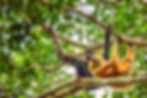
Orange gibbons are females or youngsters, while the black ones are males. This beautifully shows that women and children are to be protected.
Orange gibbons are females or youngsters, while the black ones are males. This beautifully shows that women and children are to be protected.
Keo Seima Wildlife Sanctuary
The Keo Seima Wildlife Sanctuary project in Cambodia is a significant effort by the Wildlife Conservation Society (WCS) to conserve a vital area of 292,690 hectares, known for its rich biodiversity and importance to local and Indigenous communities. This project, launched in partnership with the Royal Government of Cambodia, aims to protect the habitat of endangered species such as the Giant Ibis, Cambodia's national bird, and to promote sustainable livelihoods by reducing emissions from deforestation and forest degradation. Over its first 10-year period (2010-2019), these conservation efforts were projected to avoid more than 14 million metric tons of CO2 emissions.
During my 12-day visit, I documented the diverse facets of this sanctuary, capturing the lives of the Bonong indigenous community and their harmonious existence with nature, traditional ceremonies, and the pressures of modernization and agricultural expansion. The imagery also includes the dedicated efforts of rangers confiscating illegal logging equipment, the presence of forest elephants, and the work of the biodiversity team in the field. These visuals underscore the ongoing need for support to preserve this critical forest area and its biodiversity.
The WCS has been pivotal in integrating the Bunong indigenous ethnic group into the design and management of the project, which faces threats from illegal logging and forest clearance for agriculture. The project's long-term conservation efforts show how tropical forests in eastern Cambodia can be preserved together with the people who live there.
For more info please visit: WCS webpage


